Clean Vehicle Tax Credits: Section 30D, Section 25E, Income Caps, and Point-of-Sale Rebates
A comprehensive guide to federal EV tax credits, vehicle MSRP thresholds, Modified AGI limits, and how point-of-sale dealer rebates work under IRS rules.
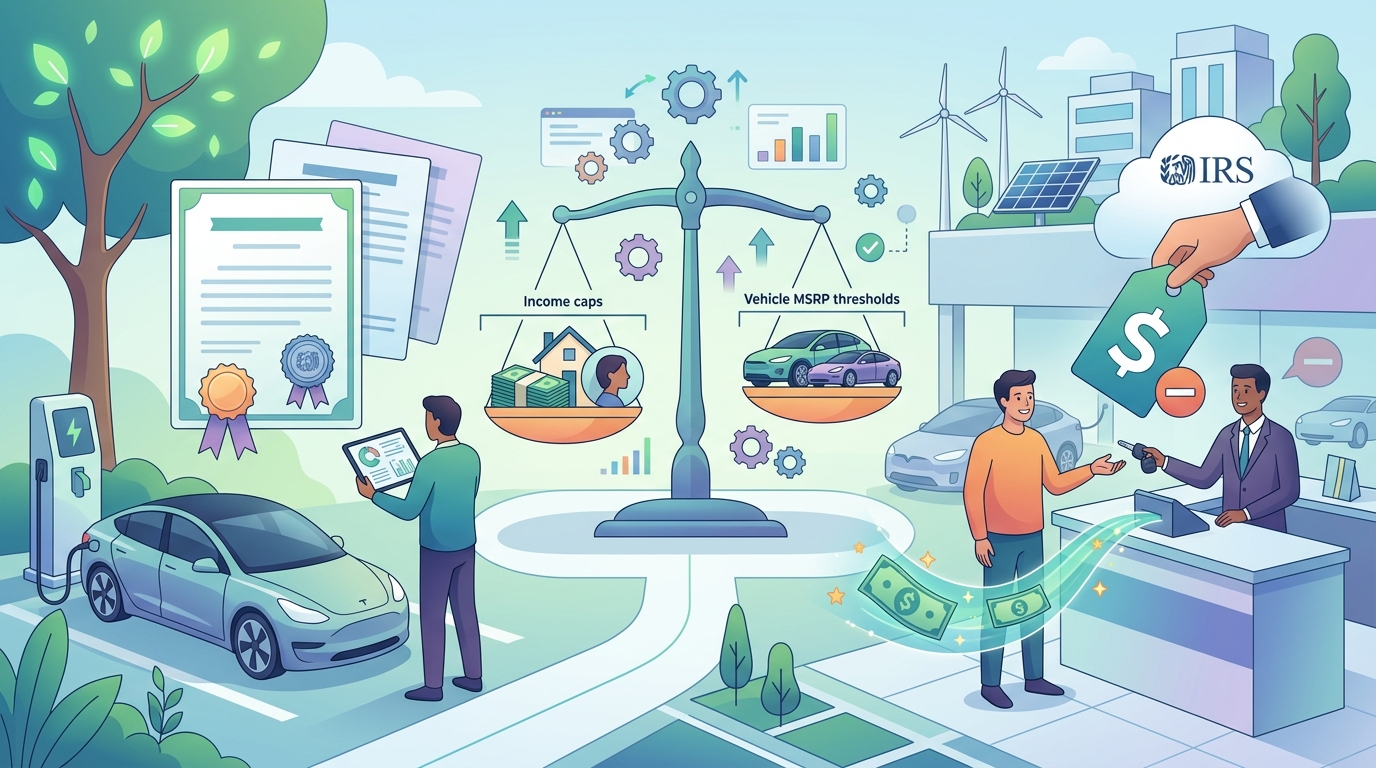
Overview of Federal Clean Vehicle Tax Credits
Federal incentives for purchasing electric and clean-energy vehicles underwent major legislative revisions under the Inflation Reduction Act. These changes restructured the existing framework into two distinct tax credits: the Section 30D new clean vehicle credit and the Section 25E used clean vehicle credit (Source 1, Source 2). The primary goal of these credits is to accelerate the adoption of zero-emission transportation while encouraging domestic supply chain development.
Starting in tax year 2024, buyers no longer have to wait until filing their annual tax returns to benefit from these incentives. Eligible taxpayers can transfer the full value of the section 30d ev tax credit or used ev credit section 25e directly to a registered automobile dealer at the point of sale (Source 3). This point of sale ev rebate dealer mechanism reduces the purchase price of the vehicle directly at checkout, functioning as an immediate down payment.
However, navigating these credits requires strict adherence to statutory rules enforced by the Internal Revenue Service (IRS) and the Department of Energy. Qualification depends on three distinct compliance checks: taxpayer income thresholds, vehicle manufacturing standards, and dealer registration compliance (Source 1, Source 3).
Section 30D New Vehicle Eligibility and MSRP Caps
To qualify for the Section 30D credit, which offers up to $7,500 for a new electric vehicle, the vehicle itself must meet strict assembly, battery component, and price requirements (Source 1). Final assembly of the vehicle must occur within North America (Source 1). Furthermore, the vehicle's Manufacturer’s Suggested Retail Price (MSRP) cannot exceed statutory caps set by vehicle classification guidelines established by Environmental Protection Agency (EPA) standards (Source 1, Source 4).
Vehicle classification determines whether an EV is held to the higher $80,000 threshold or the lower $55,000 threshold. Vans, sport utility vehicles (SUVs), and pickup trucks qualify under the $80,000 MSRP limit, while sedans, hatchbacks, and passenger cars fall under the $55,000 limit (Source 1). Buyers should consult the official qualifying electric vehicles list irs maintained on FuelEconomy.gov to verify that a specific vehicle VIN and trim level fall below these caps (Source 4).
| Vehicle Category | Maximum Eligible MSRP | Maximum Credit Amount |
|---|---|---|
| Vans | $80,000 | $7,500 |
| Sport Utility Vehicles (SUVs) | $80,000 | $7,500 |
| Pickup Trucks | $80,000 | $7,500 |
| Sedans and Passenger Cars | $55,000 | $7,500 |
The total maximum $7,500 credit is divided into two separate $3,750 portions based on battery sourcing (Source 1). The first $3,750 portion depends on whether a required percentage of critical minerals contained in the battery were extracted or processed in the United States or a free-trade partner nation (Source 1). The second $3,750 portion depends on whether a required percentage of battery components were manufactured or assembled in North America (Source 1). If a vehicle satisfies only one requirement, it qualifies for a partial credit of $3,750 (Source 1).
Modified AGI Income Limits for New and Used EVs
Taxpayer eligibility for both clean vehicle credits depends directly on Modified Adjusted Gross Income (MAGI) thresholds (Source 1, Source 2). For the purposes of these credits, MAGI is defined as adjusted gross income plus any excluded foreign earned income, foreign housing amounts, or income from U.S. possessions (Source 1). If a buyer's MAGI exceeds the legal cap for their tax filing status, they cannot claim the credit or retain a point-of-sale rebate (Source 1, Source 3).
To accommodate annual income fluctuations, the IRS allows buyers to evaluate ev tax credit income limits using either the tax year in which the vehicle is delivered or the immediately preceding tax year (Source 1, Source 2). If a buyer's MAGI falls below the limit in either of those two years, they qualify for the tax benefit (Source 1). Taxpayers cannot look back to earlier tax years beyond those two windows.
| Filing Status | Section 30D New EV MAGI Cap | Section 25E Used EV MAGI Cap |
|---|---|---|
| Married Filing Jointly / Surviving Spouse | $300,000 | $150,000 |
| Head of Household | $225,000 | $112,500 |
| All Other Filers (Single / Married Filing Separately) | $150,000 | $75,000 |
Consider a single filer who purchases a new EV in 2024. If their MAGI was $160,000 in 2024 but $145,000 in 2023, they can use their 2023 income to meet the compliance test because it falls below the $150,000 cap for single filers (Source 1).
Section 25E Used EV Credit Rules and Purchase Caps
The Section 25E credit applies to pre-owned plug-in electric and fuel cell vehicles purchased from a licensed dealer (Source 2). The credit equals 30% of the sale price of the used vehicle, up to a statutory maximum benefit of $4,000 (Source 2). Unlike the new EV credit, battery sourcing rules do not apply to used vehicles under Section 25E (Source 2).
To qualify under Section 25E rules, the used vehicle must meet several statutory requirements (Source 2):
- The purchase price must be $25,000 or less, including all dealer fees but excluding government taxes and registration fees (Source 2).
- The vehicle model year must be at least two years older than the calendar year in which it is purchased (Source 2). For example, a vehicle bought in 2024 must be model year 2022 or older.
- The vehicle must be purchased from a licensed automobile dealer; private-party sales between individuals do not qualify (Source 2).
- The vehicle must not have been previously transferred to another buyer after December 31, 2022, in a sale that triggered a Section 25E claim (Source 2).
- The buyer must be an individual purchasing the vehicle for personal use, must not be claimed as a dependent on another tax return, and cannot have claimed a Section 25E credit in the prior three years (Source 2).
The purchase price cap of $25,000 is rigid. If a used EV sells for $25,001, the entire purchase fails to qualify for the used ev credit section 25e (Source 2). Additionally, a vehicle's eligibility history is linked to its Vehicle Identification Number (VIN); once a used EV receives a Section 25E credit transfer after 2022, subsequent buyers cannot claim the credit on that same VIN again (Source 2).
How Point-of-Sale Transfers Work at Registered Dealerships
Beginning in 2024, buyers can opt to transfer their clean vehicle tax credit directly to a dealer at the time of purchase (Source 3). By transferring the credit, the buyer receives an equivalent cash reduction or down payment applied directly to the vehicle's purchase price rather than waiting to claim a credit on their annual tax return (Source 3).
For a point-of-sale transfer to occur, the selling dealer must complete registration on the IRS Energy Credits Online portal prior to the sale (Source 3). Dealerships that are not registered on this platform cannot offer point-of-sale rebates or generate valid seller reports (Source 3).
At the time of sale, the dealer must input the transaction details into the IRS Energy Credits Online portal and submit a seller report (Source 3). The portal verifies the vehicle's VIN and generates a real-time confirmation receipt (Source 3). The dealer must provide a copy of this accepted seller report to the buyer (Source 3). Under IRS rules, the dealer must submit this documentation within three calendar days of the sale date (Source 3).
Step-by-Step Buyer Checklist at the Dealership
To ensure point-of-sale rebate requests comply with IRS regulations, buyers should complete the following verification steps before signing purchase agreements:
- Verify MAGI Eligibility: Calculate your Modified AGI for both the current tax year and the previous tax year to confirm compliance with IRS caps (Source 1, Source 2).
- Check Dealership Registration: Confirm that the selling dealership is actively registered on the IRS Energy Credits Online portal (Source 3).
- Confirm Vehicle MSRP or Used Price: Verify that a new vehicle's MSRP falls below $80,000 for SUVs/trucks or $55,000 for sedans (Source 1). For used vehicles, confirm the total sale price is $25,000 or less (Source 2).
- Review Official List: Ensure the specific VIN and trim appear on the qualifying electric vehicles list irs maintained on FuelEconomy.gov (Source 4).
- Obtain Confirmation Report: Before taking delivery of the vehicle, obtain a signed copy of the IRS Energy Credits Online confirmation report directly from the dealer (Source 3).
Tax Return Reconciliation and Recapture Rules
Receiving a point-of-sale transfer at a dealership does not remove a buyer's duty to report the transaction to the IRS (Source 1, Source 3). When filing income taxes for the year in which the vehicle was delivered, the buyer must attach IRS Form 8936 (Clean Vehicle Credits) to their tax return (Source 1).
Form 8936 reconciles the credit amount received at the dealership with the buyer's actual tax return data (Source 1). If a buyer transferred the credit to the dealer but their actual MAGI exceeded the income limit in both the year of purchase and the prior year, the IRS will recapture the credit (Source 1, Source 3). In that situation, the excess benefit received at the dealership must be paid back to the IRS as an additional tax liability on Form 1040 (Source 3).
However, if a buyer's income is within the allowable caps, but their total federal tax liability for the year is less than the credit amount received (e.g., receiving a $7,500 rebate while owing only $2,000 in income tax), the IRS does not recapture the difference for point-of-sale transfers (Source 3). The buyer retains the full rebate amount granted at the point of sale (Source 3).
Can I claim the Section 25E used EV credit if I buy from a private seller?
No. The Section 25E used clean vehicle credit requires the vehicle to be purchased from a licensed dealer registered with the IRS Energy Credits Online portal. Sales between private individuals are not eligible (Source 2, Source 3).
What happens if my income exceeds the MAGI limit after I take the point-of-sale rebate?
If your Modified AGI exceeds the legal threshold in both the year of delivery and the preceding tax year, you must repay the credit amount to the IRS when you file Form 8936 with your annual tax return (Source 1, Source 3).
Are dealer fees included in the $25,000 limit for used EVs?
Yes. The $25,000 purchase price cap under Section 25E includes all dealer fees and mandatory add-on costs charged by the seller, but excludes state and local taxes, title fees, and registration charges (Source 2).
Sources
- New Clean Vehicle Credit (Section 30D Requirements and Income Limits) — Internal Revenue Service
- Used Clean Vehicle Credit (Section 25E Requirements) — Internal Revenue Service
- Clean Vehicle Credit Seller and Dealer Requirements — Internal Revenue Service
- Federal Tax Credits for Eligible Plug-in Electric and Fuel Cell Vehicles — U.S. Department of Energy
This article is for general information only and is not professional advice. Figures come from public sources and change over time; check the official source before you act.
More from Quick Money Net
- 5 Device Trade In Mistakes Stopping You From Getting Free iPhones
- See The $65 Monthly Fees Hiding In Free iPhone Carrier Deals
- Medicare Part B Late Enrollment Penalty: Calculation Formula and Appeal Eligibility
- See the $1,500 Dental Implant Allowance Most Insurers Hide
- How to Find Dental Schools Offering Free Implants Near You
- 7 Real Programs That Pay for Dental Implants Right Now