Section 25D Clean Energy Tax Credit: Eligible Solar, Battery, and Geothermal Expenses
Understand Section 25D tax credit guidelines for solar panels, battery storage, and geothermal systems, including IRS Form 5695 instructions and carryforward rules.
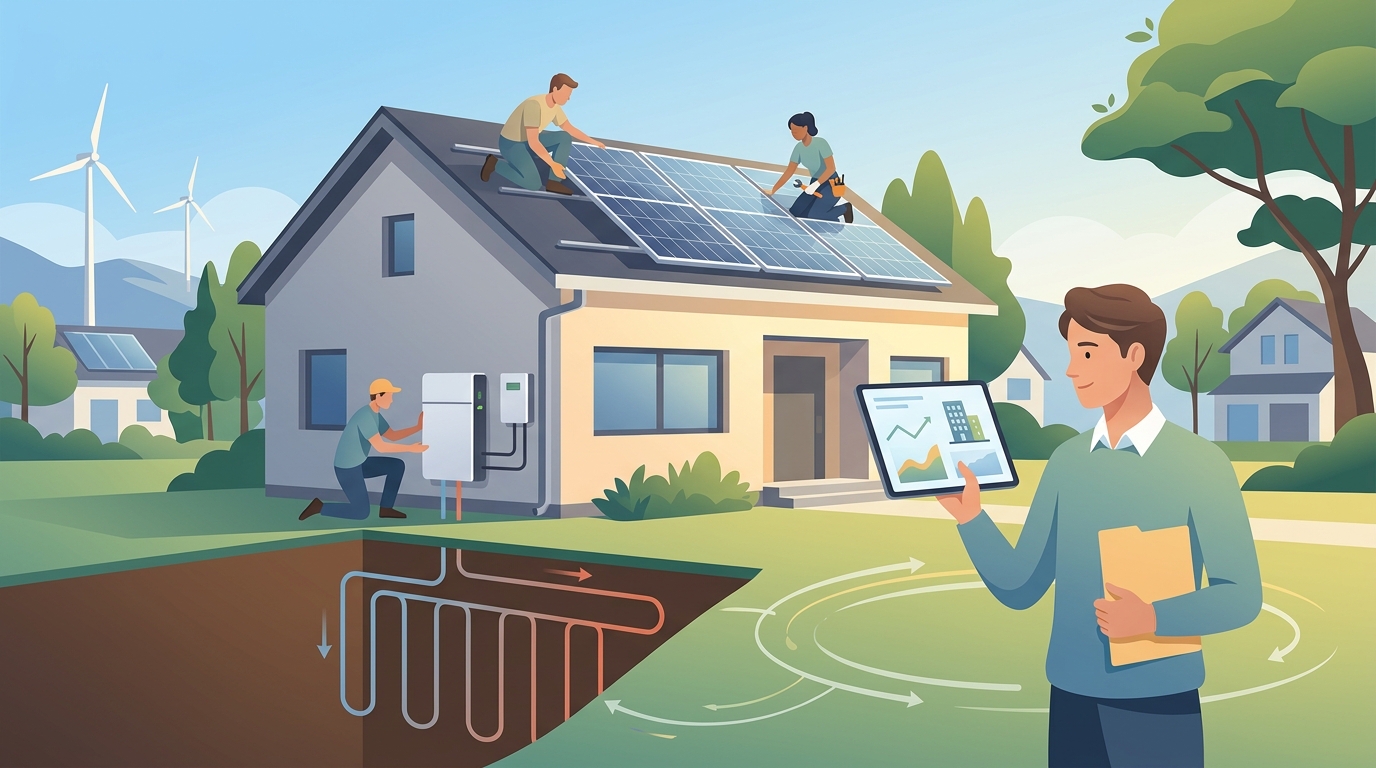
Overview of Section 25D Clean Energy Tax Credit Rules
The Section 25D Residential Clean Energy Credit allows taxpayers to claim a percentage of qualified clean energy equipment installed in homes located in the United States (Source 1). Reauthorized and expanded under the Inflation Reduction Act of 2022, this tax credit covers qualified residential solar, wind, geothermal, and battery storage investments (Source 1). Understanding the residential clean energy credit rules helps property owners calculate their potential tax savings accurately and maintain full compliance with federal requirements (Source 1).
The current statutory structure provides a 30% tax credit rate for eligible property placed in service from tax year 2022 through 2032 (Source 1). A phased step-down schedule begins in subsequent years, lowering the available percentage before statutory expiration unless extended by federal legislation (Source 1):
- Tax Years 2022 through 2032: 30% credit rate of total qualifying system costs (Source 1).
- Tax Year 2033: 26% credit rate of total qualifying system costs (Source 1).
- Tax Year 2034: 22% credit rate of total qualifying system costs (Source 1).
- Tax Year 2035 and later: 0% credit rate, unless Congress acts to extend the provision (Source 1).
The credit is nonrefundable, meaning it directly reduces federal income tax liability dollar-for-dollar down to zero, but it does not produce a direct cash refund for any excess beyond total tax owed for that filing year (Source 1). However, unused credit amounts carry forward into future tax filing periods (Source 1).
Eligible Clean Energy Technologies and Technical Criteria
To qualify for the section 25d tax credit solar and renewable energy incentives, equipment must meet specific statutory requirements set by the Internal Revenue Service and federal energy standard agencies (Source 1). Qualifying systems must be installed in connection with a residential unit used as a residence by the taxpayer (Source 1).
The primary categories of qualifying residential property include:
- Solar Photovoltaic (PV) Panels: Systems generating electricity for residential use through solar cell arrays (Source 1).
- Solar Water Heaters: Equipment designed to heat water for residential use, provided at least half of the energy generated comes from the sun (Source 1). Systems must be certified by the Solar Rating & Certification Corporation (SRCC) or an equivalent entity, and equipment used for swimming pools or hot tubs does not qualify (Source 1).
- Battery Storage Technology: Standalone or solar-paired energy storage property with a minimum rated capacity of 3 kilowatt-hours (kWh) installed in 2023 or later (Source 1).
- Geothermal Heat Pump Systems: Ground-source or water-source heat pumps that extract heat from the earth or groundwater (Source 1). Equipment must meet Energy Star requirements in effect at the time of purchase (Source 1).
- Small Wind Energy Property: Wind turbines that generate electricity for residential property usage (Source 1).
- Fuel Cell Property: Systems that generate electricity using fuel cell technology, subject to a limit of $500 for each half-kilowatt of capacity (Source 1).
| Technology Category | Technical Requirement | Applicable Credit Rate (2022–2032) | Eligible Property Usage |
|---|---|---|---|
| Solar Photovoltaics (PV) | Generates electricity for residential use | 30% | Primary and secondary residences |
| Battery Storage | Rated capacity of 3 kWh or greater | 30% | Primary and secondary residences |
| Geothermal Heat Pumps | Meets Energy Star standards at purchase | 30% | Primary and secondary residences |
| Solar Water Heating | SRCC certified; excludes pools/hot tubs | 30% | Primary and secondary residences |
| Fuel Cell Systems | 0.5 kW minimum capacity; primary home only | 30% (capped at $500/0.5 kW) | Principal residence only |
Qualifying Installation, Labor, and Direct System Expenses
When calculating total eligible expenditures, taxpayers can include direct labor costs alongside equipment purchase prices (Source 1). Eligible expenditures include costs directly attributed to onsite preparation, assembly, original installation, and electrical interconnections (Source 1).
Qualifying installation expenses encompass:
- Onsite labor costs for initial installation, wiring, assembly, and mounting (Source 1).
- Piping and electrical wiring necessary to connect equipment to the home's electrical grid or plumbing network (Source 1).
- System controls, inverters, charge controllers, and monitoring equipment integral to system operation (Source 1).
- Permitting fees, utility interconnection fees, and inspection costs directly related to equipment installation (Source 1).
For example, if a homeowner spends $18,000 on solar PV panels and inverters, $4,000 on onsite labor, and $1,000 on utility interconnection fees, the total eligible expenditure is $23,000 (Source 1). Applying the 30% credit rate yields a tax credit calculation of $6,900 ($23,000 x 0.30) (Source 1).
Non-Qualifying Roof Repairs and Structural Cost Exclusions
A common area of confusion involves roof repairs, structural reinforcement, and home improvements made alongside renewable energy installations. IRS guidelines strictly distinguish between functional clean energy property and traditional structural components of a home (Source 1). Traditional structural building components do not qualify for Section 25D tax credits (Source 1).
The following expenditures are generally excluded from the Section 25D credit:
- Roof Replacements and Structural Repairs: Replacing traditional asphalt shingles, slate, tiles, or metal roofing prior to installing solar panels does not qualify, even if the roof repair is required to support the panels (Source 1).
- Structural Framing and Rafter Reinforcements: Costs to strengthen trusses, rafters, or load-bearing walls to accommodate panel weight are considered structural costs and are non-qualifying (Source 1).
- Aesthetic and Landscaping Expenses: Removing trees to clear shade, repainting, or adding decorative trim around panels cannot be included in eligible costs (Source 1).
- Electrical Panel Upgrades (with limits): Main service panel upgrades solely performed to increase home electrical capacity do not automatically qualify under Section 25D unless they are strictly installed to enable the clean energy generation equipment (Source 1).
An exception exists for solar roofing tiles or solar shingles that serve a dual purpose (Source 1). Solar roof tiles that actually generate electricity qualify as solar electric property (Source 1). However, non-solar structural components installed alongside them do not qualify (Source 1). Property owners must respect solar panel tax deduction limits by separating non-qualifying structural costs from eligible solar system expenses on contractor invoices (Source 1).
How to File IRS Form 5695 for Section 25D Credit
Taxpayers must report eligible clean energy expenses on IRS Form 5695, Residential Energy Credits, and submit it alongside Form 1040 when filing annual income tax returns (Source 1). Following clear irs form 5695 instructions ensures that all costs are calculated correctly and credited against federal tax liability (Source 1).
Step-by-step breakdown of claiming the Section 25D credit using Form 5695, Part I:
- Line 1: Enter total qualified solar electric property costs paid during the tax year (Source 1).
- Line 2: Enter total qualified solar water heating property costs (Source 1).
- Line 3: Enter total qualified small wind energy property costs (Source 1).
- Line 4: Enter total qualified geothermal heat pump property costs (Source 1).
- Line 5a: Enter qualified battery storage technology costs for systems with at least 3 kWh capacity (Source 1).
- Line 6a: Calculate the sum of lines 1 through 5a to establish total baseline clean energy expenditures (Source 1).
- Line 6b: Multiply line 6a by 30% (0.30) to compute the tentative credit amount (Source 1).
- Line 13: Calculate tax liability limitations using the IRS tax liability limit worksheet to establish allowable current-year credit (Source 1).
- Line 14: Transfer the final allowed credit to Schedule 3 (Form 1040), line 5a (Source 1).
Taxpayers should maintain detailed records, including itemized contractor invoices, specification sheets showing battery storage capacity in kWh, purchase receipts, and manufacturer certifications for geothermal heat pumps (Source 1).
Nonrefundable Tax Limits and Unused Credit Carryforward Provisions
Because Section 25D is a nonrefundable tax credit, the maximum amount claimed in a single tax year cannot exceed the taxpayer's total federal income tax liability for that year (Source 1). Tax liability refers to total federal income tax owed after applying standard deductions and nonrefundable personal credits, but prior to applying tax withholdings or estimated payments (Source 1).
If a taxpayer calculates a $9,000 clean energy tax credit on Form 5695 but only owes $6,000 in total federal income tax for that year, the current year's credit applied to income tax is capped at $6,000 (Source 1). The remaining $3,000 credit does not expire; instead, it carries forward to the following tax year (Source 1).
Key rules regarding carryforward provisions include:
- Indefinite Rollover: Unused credit amounts continue carrying forward to subsequent tax years for as long as the Section 25D statutory credit remains active (Source 1).
- Sequential Application: In the following tax year, carried-forward credit balances apply before or alongside new credit claims according to Form 5695 ordering instructions (Source 1).
- No Direct Cash Refunds: Excess credit cannot be refunded directly as cash if income tax liability reaches $0 (Source 1).
Property Eligibility: Primary Residences, Second Homes, and Rentals
Eligibility for the Section 25D credit depends on how the taxpayer uses the residential property where equipment is installed (Source 1).
Residency and usage rules vary across equipment types:
- Primary Residences: All qualifying equipment—solar PV, solar water heaters, battery storage tax credit irs eligible systems, geothermal heat pumps, small wind, and fuel cells—qualify when installed in a principal residence owned and used by the taxpayer (Source 1).
- Secondary and Vacation Homes: Solar PV, battery storage, solar water heating, and geothermal systems installed in secondary residences qualify for the credit, provided the taxpayer uses the property as a residence and does not lease it out to tenants (Source 1). Fuel cell property does not qualify for secondary homes (Source 1).
- Rental Properties: Property owners cannot claim Section 25D credits for equipment installed on residential properties used exclusively as tenant rentals (Source 1). If the owner lives in a multi-unit building and rents out remaining units, expenditures must be prorated based on personal residential use space (Source 1).
- New Construction Homes: Homeowners purchasing newly constructed homes can claim the credit in the year they occupy the home, provided the builder itemizes clean energy equipment costs and certifies that no builder-level tax credits were claimed (Source 1).
Can I claim the Section 25D tax credit if I lease my solar panels or battery storage system?
No. Only the legal owner of the clean energy system can claim the Section 25D tax credit (Source 1). If you enter into a lease agreement or a Power Purchase Agreement (PPA) with a solar developer, the developer owns the equipment and receives the credit benefits rather than the homeowner (Source 1).
Does standalone battery storage qualify for the tax credit if it is not connected to solar panels?
Yes. Beginning in tax year 2023, standalone energy storage property with a capacity of 3 kilowatt-hours (kWh) or greater qualifies for the 30% credit under Section 25D, regardless of whether it is charged by solar panels or grid electricity (Source 1).
How long can I carry forward unused tax credit amounts from IRS Form 5695?
Unused Section 25D tax credit balances carry forward to subsequent tax years as long as the federal residential clean energy credit program remains active (Source 1). There is no annual cap on the dollar value carried forward (Source 1).
Sources
- Residential Clean Energy Credit Details — Internal Revenue Service
This article is for general information only and is not professional advice. Figures come from public sources and change over time; check the official source before you act.
More from Quick Money Net
- 5 Device Trade In Mistakes Stopping You From Getting Free iPhones
- See The $65 Monthly Fees Hiding In Free iPhone Carrier Deals
- Medicare Part B Late Enrollment Penalty: Calculation Formula and Appeal Eligibility
- See the $1,500 Dental Implant Allowance Most Insurers Hide
- How to Find Dental Schools Offering Free Implants Near You
- 7 Real Programs That Pay for Dental Implants Right Now