SSDI vs. SSI Disability Benefits: Income Limits, Work Credits, and Medical Qualifications
Understand the legal and financial differences between Social Security Disability Insurance (SSDI) and Supplemental Security Income (SSI), including work credit math, asset limits, SGA thresholds, and healthcare eligibility.
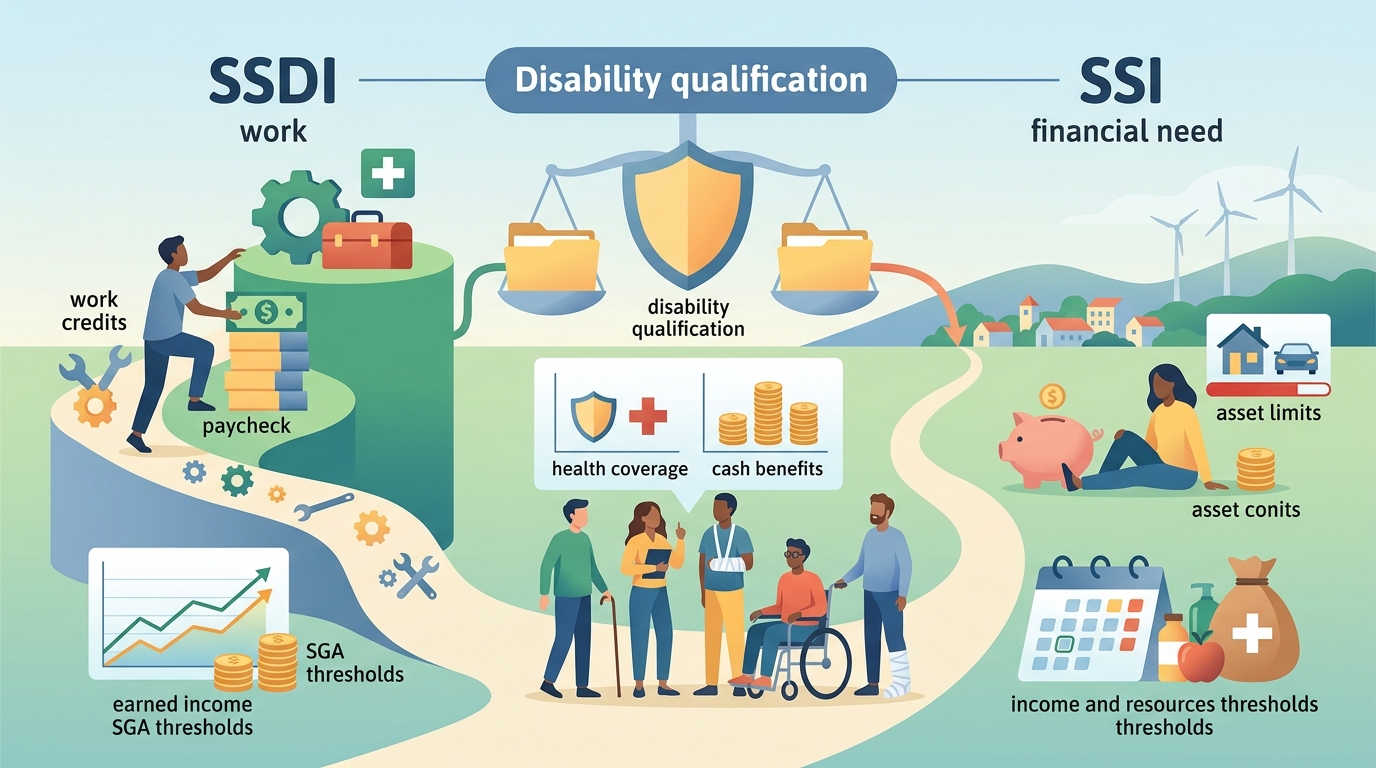
Understanding Federal Disability Programs: SSDI vs. SSI Overview
The Social Security Administration (SSA) administers two primary federal disability programs: Social Security Disability Insurance (SSDI) under Title II of the Social Security Act and Supplemental Security Income (SSI) under Title XVI (Source 1, Source 2). While both programs share identical medical standards for determining disability, their financial entitlement rules, funding sources, and secondary healthcare benefits differ significantly.
SSDI operates as an earned social insurance plan for individuals who have paid Social Security taxes on past earnings through Federal Insurance Contributions Act (FICA) deductions (Source 1). Benefits are funded through the Disability Insurance Trust Fund, and monthly payments rely directly on an applicant's lifetime average indexed monthly earnings rather than financial need (Source 1, Source 6).
In contrast, SSI is a federal welfare assistance program financed through general tax revenues rather than FICA taxes (Source 2). It provides monthly cash payments to low-income aged, blind, or disabled individuals regardless of past employment records (Source 7). Understanding the distinct technical criteria—such as ssdi vs ssi income limits, social security disability work credits, and strict resource maximums—is crucial when navigating the application process.
SSDI Work Credit Requirements and Quarter of Coverage Math
To qualify for SSDI, applicants must demonstrate sufficient recent work history covered under Social Security taxes (Source 6). Eligibility is measured in Quarter of Coverage (QC) units, commonly called work credits. Workers earn up to a maximum of four work credits per calendar year based on their total earned wages or self-employment income (Source 6).
The calculation for social security disability work credits depends on the individual's age at the onset of the disability. The SSA applies two primary tests: the duration-of-work test (total lifetime credits) and the recent-work test (credits earned in the years immediately preceding disability onset) (Source 6).
- Disabled before age 24: You generally need 6 credits (1.5 years of work) earned in the 3-year period ending when your disability started (Source 6).
- Disabled between ages 24 and 31: You need credits for working half the time between age 21 and the quarter your disability began (Source 6).
- Disabled at age 31 or older: You generally need at least 20 credits earned in the 10 years immediately preceding disability onset, alongside a total credit count ranging from 20 to 40 depending on exact age (Source 6).
| Age at Disability Onset | Recent Work Requirement | Total Minimum Credits Needed |
|---|---|---|
| Under 24 | 6 credits in prior 3 years | 6 credits |
| 24 to 30 | Credits for half the time since age 21 | 6 to 18 credits |
| 31 to 42 | 20 credits in 10 years before onset | 20 credits |
| 50 | 20 credits in 10 years before onset | 28 credits |
| 60 | 20 credits in 10 years before onset | 38 credits |
SSI Income and Resource Limits
Unlike SSDI, SSI eligibility does not rely on past work history. Instead, applicants must meet strict financial need standards governed by asset and income rules (Source 2, Source 7). These limits apply to countable resources owned by the applicant and, in some cases, deemed resources from a spouse or parent (Source 7).
The statutory asset limit for SSI eligibility is capped strictly at $2,000 for an individual and $3,000 for an eligible couple living together (Source 7). A resource includes cash, bank accounts, stocks, bonds, land, and personal property that could be converted to cash (Source 7).
However, the SSA excludes certain essential assets when calculating countable resources for SSI (Source 7):
- The primary home occupied by the claimant and the land it sits on (Source 7).
- One primary vehicle used for transportation by the claimant or household members (Source 7).
- Basic household goods, personal effects, and life insurance policies with a face value below set regulatory limits (Source 7).
- Funds set aside in designated burial spaces or burial funds up to $1,500 per individual (Source 7).
Regarding monthly earnings and ssdi vs ssi income limits, SSI checks are reduced based on an applicant's countable income (Source 7). The SSA divides income into earned (wages, self-employment) and unearned (SSDI, pensions, interest, gifts) categories (Source 7). General income exclusions allow individuals to exclude the first $20 of unearned income and the first $65 of earned income plus half of the remaining earned earnings each month (Source 7).
Substantial Gainful Activity (SGA) Thresholds
Both SSDI and SSI enforce a financial work test called Substantial Gainful Activity (SGA). SGA represents a specific monthly earnings threshold used by the SSA to evaluate whether a claimant's work activity is significant enough to demonstrate the capacity for competitive employment (Source 8).
If an applicant without statutory blindness earns gross wages exceeding the substantial gainful activity sga limit after allowable deductions, the SSA will generally find that the individual is not disabled, regardless of medical condition severity (Source 6, Source 8). The SSA updates these thresholds annually to reflect changes in national wage indexes (Source 8).
| SGA Category | Evaluation Criteria | Impact on Initial Application |
|---|---|---|
| Non-Blind Individuals | Gross monthly wage threshold set by SSA annually | Earnings above threshold result in medical denial |
| Statutorily Blind Individuals | Higher statutory monthly wage threshold | Earnings evaluated under higher blind SGA limit |
| Self-Employed Workers | Evaluated on gross income and hours/services rendered | Hours worked and comparability to non-disabled work applied |
Claimants working while disabled can reduce their countable earnings for SGA calculations by documenting Impairment-Related Work Expenses (IRWE) (Source 4). IRWE includes out-of-pocket costs for specialized transportation, medical devices, attendant care, or prescription medications necessary for the individual to perform work (Source 4).
The SSA Five-Step Sequential Evaluation Process for Medical Qualifications
To establish ssdi medical qualifications or SSI disability eligibility, applicants must satisfy identical statutory definitions of disability (Source 3, Source 6). The claimant must suffer from a medically determinable physical or mental impairment that prevents substantial gainful activity and is expected to result in death or last for a continuous period of not less than 12 months (Source 6).
Adjudicators follow the SSA Five-Step Sequential Evaluation Process to evaluate disability claims (Source 6):
- Step 1: Current Work Activity. Is the applicant working above the current monthly SGA limit? If yes, the claim is denied (Source 6, Source 8).
- Step 2: Severity of Impairment. Does the applicant have a severe impairment that significantly limits basic work activities for at least 12 months? If no, the claim is denied (Source 6).
- Step 3: Blue Book Listings. Does the impairment meet or medically equal a listing in the SSA Disability Evaluation Under Social Security manual (ssdi blue book listing)? If yes, disability is automatically granted without further steps (Source 3, Source 6).
- Step 4: Past Relevant Work. Does the applicant retain the Residual Functional Capacity (RFC) to perform work performed within the past 5 years? If yes, the claim is denied (Source 6).
- Step 5: Other Work Capability. Can the applicant adjust to alternative work existing in significant numbers in the national economy, considering their RFC, age, education, and work experience? If yes, the claim is denied; if no, benefits are approved (Source 6).
Healthcare Linkage: Medicare vs. Medicaid Rules
Receiving disability benefits provides essential access to federal or state health insurance programs, but the entitlement timeline depends on whether the beneficiary receives SSDI or SSI (Source 5, Source 10).
For SSDI recipients, entitlement to Medicare Part A and Part B requires a mandatory 24-month waiting period (Source 5, Source 9). This 24-month period begins after the beneficiary completes their fifth full calendar month of entitlement to SSDI cash payments (Source 5, Source 9). The 24-month waiting period is waived statutorily for individuals diagnosed with Amyotrophic Lateral Sclerosis (ALS) or End-Stage Renal Disease (ESRD) (Source 5).
For SSI beneficiaries, healthcare access is provided through state-administered Medicaid programs (Source 10). In most states (referred to as Section 1634 states), qualifying for SSI automatically grants immediate Medicaid coverage without a separate application or waiting period (Source 10). In states using different eligibility criteria, SSI beneficiaries must complete a separate state Medicaid application (Source 10).
Comparative Summary: SSDI vs. SSI Requirements
While both programs require identical medical evidence under the 5-step evaluation process, their non-medical technical requirements differ across several operational parameters (Source 1, Source 2, Source 6).
| Program Feature | Social Security Disability Insurance (SSDI) | Supplemental Security Income (SSI) |
|---|---|---|
| Target Audience | Insured disabled workers with past earnings (Source 1) | Low-income disabled, blind, or aged individuals (Source 2) |
| Work History | Requires minimum quarters of work credits (Source 6) | No work credit or employment history required (Source 7) |
| Resource Limit | No limit on personal savings or owned assets (Source 1) | Strict limit: $2,000 individual / $3,000 couple (Source 7) |
| Medical Standard | 5-Step Sequential Evaluation Process (Source 6) | 5-Step Sequential Evaluation Process (Source 6) |
| SGA Application | Applies to initial claim and trial work rules (Source 4, Source 8) | Applies to initial claim eligibility (Source 8) |
| Health Insurance | Medicare after 24-month waiting period (Source 5) | Medicaid immediately in most states (Source 10) |
Can an individual receive both SSDI and SSI payments simultaneously?
Yes. An individual can receive concurrent benefits if their monthly SSDI payment is lower than the federal SSI benefit rate and their total resources fall below the SSI threshold of $2,000 for an individual or $3,000 for a couple (Source 1, Source 7).
How does returning to work affect SSDI benefits compared to SSI?
SSDI includes a Trial Work Period (TWP) allowing beneficiaries to test their ability to work for 9 months without losing cash benefits regardless of earnings (Source 4). SSI does not use a Trial Work Period; instead, monthly SSI cash payments are directly reduced based on countable monthly earned income (Source 4, Source 7).
What happens if a claimant's condition is severe but does not meet a Blue Book listing?
If an impairment does not meet an explicit listing in the SSA Blue Book at Step 3, adjudicators assess the claimant's Residual Functional Capacity (RFC) (Source 3, Source 6). If the RFC demonstrates the individual cannot perform past work or any other substantial work in the national economy, benefits can still be granted at Step 5 (Source 6).
Sources
- Social Security Disability Benefits — Social Security Administration
- Supplemental Security Income (SSI) — Social Security Administration
- Disability Evaluation Under Social Security (Blue Book) — Social Security Administration
- The Red Book: A Guide to Work Incentives and Employment Support — Social Security Administration
- Medicare Eligibility & Enrollment — Centers for Medicare & Medicaid Services
- Disability Benefits: How You Qualify — Social Security Administration
- Supplemental Security Income (SSI) — Social Security Administration
- Substantial Gainful Activity (SGA) — Social Security Administration
- How Do I Get Medicare? — Centers for Medicare & Medicaid Services
- Medicaid Eligibility Overview — Centers for Medicare & Medicaid Services
This article is for general information only and is not professional advice. Figures come from public sources and change over time; check the official source before you act.
More from Quick Money Net
- 5 Device Trade In Mistakes Stopping You From Getting Free iPhones
- See The $65 Monthly Fees Hiding In Free iPhone Carrier Deals
- Medicare Part B Late Enrollment Penalty: Calculation Formula and Appeal Eligibility
- See the $1,500 Dental Implant Allowance Most Insurers Hide
- How to Find Dental Schools Offering Free Implants Near You
- 7 Real Programs That Pay for Dental Implants Right Now