Backdoor Roth IRA Tax Guide: IRS Form 8606 Rules and Pro-Rata Calculation
Learn how high-income earners execute the backdoor Roth IRA strategy, file IRS Form 8606, and handle the pro-rata rule to prevent double taxation.
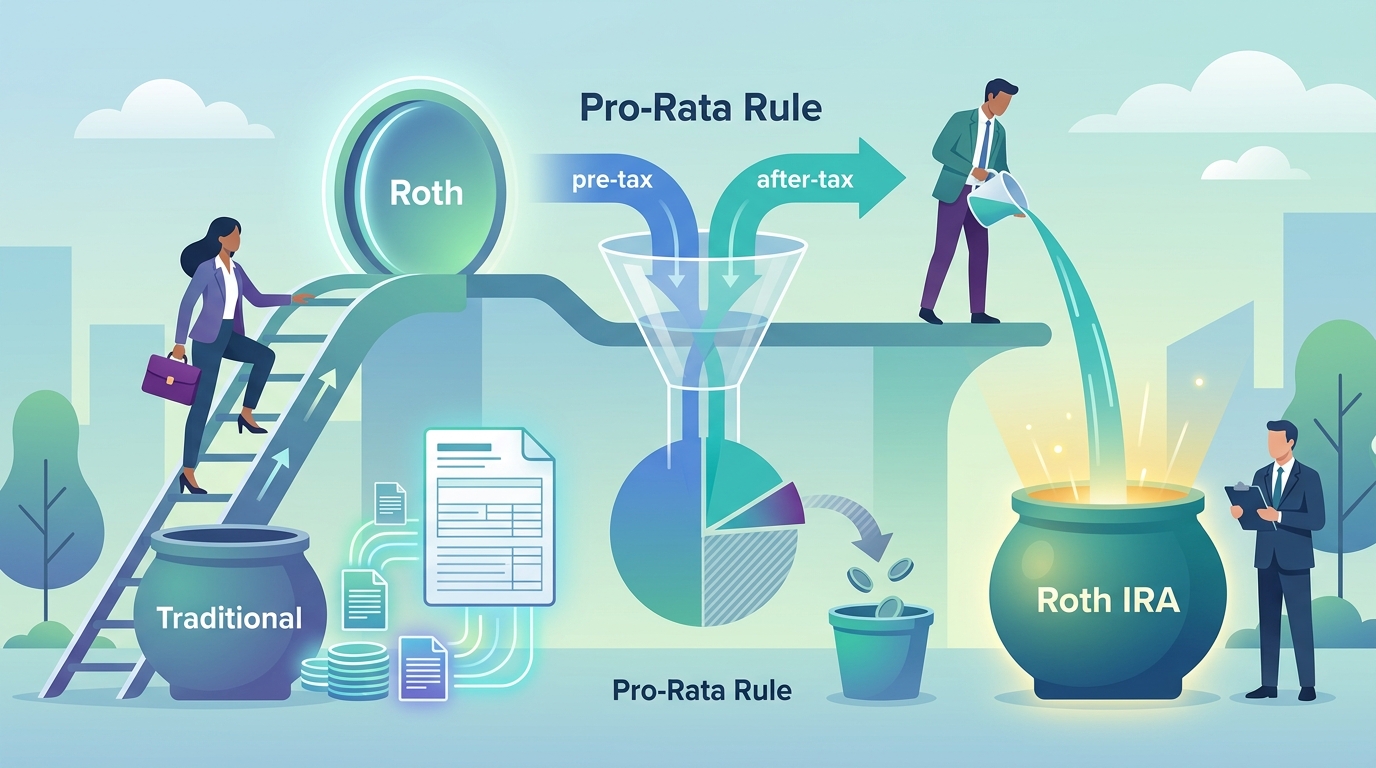
High-income taxpayers often find themselves locked out of direct Roth IRA contributions due to statutory income thresholds established by the Internal Revenue Service (Source 1). However, Federal tax code provisions allow individuals regardless of income level to make non-deductible contributions to a Traditional IRA and subsequently convert those funds into a Roth IRA (Source 1, Source 2). This multi-step process is commonly referred to as a backdoor Roth IRA strategy.
While the strategy is widely utilized, executing a backdoor Roth IRA requires strict compliance with IRS tax accounting regulations. Failing to properly calculate pre-tax and post-tax IRA balances or omitting required tax filings can lead to unintended tax liabilities and double taxation (Source 2). This comprehensive guide explains the statutory income rules, step-by-step contribution mechanics, the IRS Aggregation and Pro-Rata rules, and precise instructions for filing IRS Form 8606.
High Income Roth IRA Eligibility and Income Phase-Out Limits
Direct contributions to a Roth IRA are subject to annual Modified Adjusted Gross Income (MAGI) limits set by the IRS (Source 1). If a taxpayer's MAGI exceeds specified phase-out thresholds based on their tax filing status, their allowable direct contribution is reduced or completely eliminated (Source 1).
- Single, Head of Household, or Married Filing Separately (if living apart all year): Direct contribution eligibility phases out above annual MAGI thresholds established by IRS fee schedules and code limits (Source 1).
- Married Filing Jointly: Combined household MAGI determines whether direct contributions are permitted or phased out entirely (Source 1).
- Married Filing Separately (living together at any time during the year): Direct Roth IRA eligibility drops to near zero, making direct contributions virtually impossible for most high earners in this filing category (Source 1).
Because these MAGI limits restrict high earners from contributing directly to a Roth IRA, individuals use non-deductible Traditional IRA contributions as an intermediary step (Source 1, Source 2). There are no income restrictions for making non-deductible contributions to a Traditional IRA, provided the taxpayer has earned income for the tax year (Source 2).
Step-by-Step Non-Deductible Traditional IRA Contribution Process
Executing a backdoor Roth IRA requires a clear sequence of transactions across designated account types. Deviating from these steps or failing to track account basis can create administrative errors during tax preparation (Source 2).
- Step 1: Open a Traditional IRA with a financial institution if an account does not already exist.
- Step 2: Deposit cash up to the annual statutory IRA contribution limit into the Traditional IRA, explicitly designating it as a non-deductible contribution (Source 2).
- Step 3: Allow the cash deposit to settle in the account. To minimize taxable earnings or interest gains accrued before conversion, keep the cash in an uninvested settlement fund (Source 2).
- Step 4: Execute a complete conversion transfer of the money from the Traditional IRA into a Roth IRA (Source 1, Source 2).
- Step 5: File IRS Form 8606 alongside annual tax returns to document the non-deductible contribution basis and the tax-exempt status of the converted principal (Source 2).
The IRS Aggregation Rule and Pro-Rata Tax Mechanics
The most significant tax trap for high earners executing a backdoor Roth IRA is the IRS Pro-Rata Rule, governed by Internal Revenue Code Section 408(d)(2) and tracked via Form 8606 (Source 2). Under the IRS Aggregation Rule, the IRS does not treat individual Traditional IRA accounts separately for tax purposes. Instead, all tax-deferred IRAs owned by a single individual are aggregated into a single valuation pool on December 31 of the tax year in which the conversion occurs (Source 2).
Accounts included in the IRS Aggregation Rule calculation include (Source 2):
- All Traditional IRAs (including rolled-over 401(k) balances)
- SEP-IRAs (Simplified Employee Pension IRAs)
- SIMPLE IRAs (Savings Incentive Match Plan for Employees)
Accounts explicitly excluded from the IRS Aggregation Rule include qualified employer plans such as 401(k), 403(b), and 457(b) plans, as well as existing Roth IRAs and Inherited IRAs (Source 2).
If an individual holds pre-tax balances in any Traditional, SEP, or SIMPLE IRA on December 31 of the calendar year they execute a Roth conversion, every dollar converted is treated as a proportional mix of pre-tax assets and post-tax basis (Source 2). Taxpayers cannot selectively choose to convert only the non-deductible (post-tax) dollar portion (Source 2).
Pro-Rata Calculation Mechanics and Practical Scenarios
The taxable portion of a Roth IRA conversion is calculated using a standard ratio set forth in IRS Form 8606 instructions (Source 2):
Non-Deductible Basis / Total Aggregated IRA Balance = Non-Taxable Percentage
To illustrate how existing pre-tax IRA balances trigger taxable income during a backdoor Roth conversion, consider the standard scenarios presented in the fee and tax schedule table below.
| Scenario Description | Total Pre-Tax IRA Balance | Non-Deductible Contribution | Amount Converted | Taxable Portion of Conversion | Tax-Free Portion of Conversion |
|---|---|---|---|---|---|
| Clean Conversion (Zero Pre-Tax IRA Balance) | $0 | $7,000 | $7,000 | $0 | $7,000 |
| Moderate Pre-Tax Balance Present | $63,000 | $7,000 | $7,000 | $6,300 | $700 |
| High Pre-Tax Balance Present | $133,000 | $7,000 | $7,000 | $6,650 | $350 |
As demonstrated in the table, having pre-tax funds across any aggregate IRA account on December 31 forces a proportional tax liability on the converted amount (Source 2). In the moderate scenario, converting $7,000 results in $6,300 of taxable income because 90% of the aggregate $70,000 IRA balance consists of pre-tax dollars (Source 2).
Filing IRS Form 8606 to Report Nondeductible Contributions
IRS Form 8606 (Nondeductible IRAs) is the official tax document used to declare non-deductible Traditional IRA contributions, calculate total account basis, and record conversions to Roth IRAs (Source 2). Filing Form 8606 accurately is necessary to establish proof that taxes were already paid on non-deductible contributions, thereby avoiding double taxation when funds are later distributed or converted (Source 2).
Key Line Items on Form 8606 Part I and Part II
- Line 1: Enter non-deductible Traditional IRA contributions made for the specific tax year (Source 2).
- Line 2: Enter total non-deductible basis carried over from prior years' Form 8606 filings (Line 14 of the prior year's tax form) (Source 2).
- Line 3: Combine Line 1 and Line 2 to establish total non-deductible IRA basis (Source 2).
- Line 6: Enter the total fair market value of all Traditional, SEP, and SIMPLE IRAs as of December 31 of the tax year, plus outstanding rollovers (Source 2).
- Line 8: Enter the total amount converted from Traditional IRAs to Roth IRAs during the calendar year (Source 2).
- Line 10: Calculate the non-taxable percentage ratio of basis to total aggregate IRA valuation (Source 2).
- Line 14: Determines remaining non-deductible basis to carry forward into future tax years (Source 2).
- Line 16 (Part II): Displays the net taxable amount of the Roth conversion to be reported on Form 1040 (Source 2).
Tax Reporting Timelines and Avoiding Double Taxation
A common source of confusion involves the reporting alignment between contribution tax years and calendar conversion years. While Traditional IRA contributions for a given tax year can be made up until the April tax filing deadline of the following calendar year, Roth conversions are strictly recognized on a calendar-year basis (Source 1, Source 2).
For example, a non-deductible contribution made in March 2025 designated for tax year 2024 is reported on Part I of the 2024 Form 8606 (Source 2). However, if the conversion from the Traditional IRA to the Roth IRA takes place in March 2025, that conversion occurs in calendar year 2025 (Source 2). Consequently, the conversion portion must be reported on Part II of the 2025 Form 8606 when filing 2025 tax returns in early 2026 (Source 2).
Taxpayers receive two official IRS reporting forms from their custodian each year (Source 2):
- Form 1099-R: Issued in January following the calendar year of conversion. Details the total distribution amount from the Traditional IRA and indicates Box 2a taxable status code (Source 2).
- Form 5498: Issued by May following the tax year. Documents total contributions, fair market value, and IRA conversion transfers processed by the broker (Source 2).
Strategies to Eliminate Pro-Rata Exposure
High-income earners who hold significant pre-tax IRA balances can use specific structural options to clear their pre-tax balances and avoid pro-rata taxation before converting (Source 2).
The most common strategy is an active employer plan reverse rollover (Source 2). If an individual participates in an active 401(k), 403(b), or 457(b) retirement plan that accepts incoming rollovers from IRAs, they can roll pre-tax Traditional IRA balances directly into the employer plan (Source 2).
Because employer qualified retirement plans are explicitly excluded from the IRS IRA aggregation calculation under Form 8606, moving pre-tax assets into a 401(k) leaves a $0 pre-tax IRA balance on December 31 (Source 2). This allows future non-deductible Traditional IRA contributions to be converted to a Roth IRA completely free of pro-rata taxation (Source 2).
What happens if I forget to file Form 8606 with my tax return?
Failing to file Form 8606 can result in an IRS penalty fee per unfiled tax return (Source 2). More importantly, omitting Form 8606 means the IRS will lack record of your non-deductible basis, potentially treating future conversions or distributions as fully taxable pre-tax income, leading to double taxation (Source 2).
Is there a time limit between making a non-deductible contribution and converting it?
IRS regulations do not specify a mandatory waiting period between making a non-deductible contribution and converting funds to a Roth IRA (Source 2). However, executing conversions promptly minimizes any earnings or interest accrued in the Traditional IRA, which would be subject to income tax upon conversion (Source 2).
Are earnings accrued in the Traditional IRA prior to conversion taxable?
Yes. Any investment growth or interest earned in the Traditional IRA between the deposit date and conversion date is considered pre-tax income (Source 2). This growth must be included as taxable income on Form 1040 for the tax year in which the conversion occurs (Source 2).
Sources
- Roth IRAs Contribution and Income Limits — Internal Revenue Service
- About Form 8606, Nondeductible IRAs — Internal Revenue Service
This article is for general information only and is not professional advice. Figures come from public sources and change over time; check the official source before you act.
More from Quick Money Net
- 5 Device Trade In Mistakes Stopping You From Getting Free iPhones
- See The $65 Monthly Fees Hiding In Free iPhone Carrier Deals
- Medicare Part B Late Enrollment Penalty: Calculation Formula and Appeal Eligibility
- See the $1,500 Dental Implant Allowance Most Insurers Hide
- How to Find Dental Schools Offering Free Implants Near You
- 7 Real Programs That Pay for Dental Implants Right Now